



SC: jurisdiction & justice – I
 -File Photo
In the wake of disqualification of three-times elected Prime Minister, Mian Muhammad Nawaz Sharif, directly by Supreme Court of Pakistan, a heated debate is going on as to whether the highest court of the country has jurisdiction to act as a trial court while exercising jurisdiction under Article 184(3) of the Constitution of Islamic Republic of Pakistan [hereinafter "the Constitution">. The main legal argument against the decision -though many are contesting it on facts and review petitions have also been filed by respondents on multiple grounds-is that it is violative of Article 10A [right to fair trial]. Article 10A, inserted through the Eighteenth Constitutional Amendment, guarantees a fundamental right that "for the determination of his civil rights and obligations or in any criminal charge against him a person shall be entitled to a fair trial and due process".
In this paper, we are not discussing the political consequences of the judgment, but confining the discussion on purely legal issues, especially the scope of jurisdiction of the Supreme Court under the Constitution. In Imran Khan v Mian Nawaz Sharif & others [Constitutional Petition No 29 of 2016], the apex court has extensively dealt with this issue. It should also be remembered that in this case before the commencement of hearings, both petitioners and respondents, on the order of the court, gave their consent in writing that they had no objection on inquisitorial jurisdiction, exercisable by Supreme Court, under Article 184(3) of the Constitution. The objections on the jurisdiction of the court by the respondents in the event of the adverse order are thus not understandable as they participated fully in the proceedings and presented thousands of documents in their support and/or for the purpose of refuting the charges levelled against them.
The establishment, jurisdiction and powers of Supreme Court, conferred by the supreme law of the land, are briefly summarized on its website as below:
In the Panama Case, one very important question raised was: "What is the scope of the proceedings before Supreme Court under Article 184(3) of the Constitution and whether disputed or intricate questions of fact can be decided in such proceedings with or without recording of evidence"?
The answers to the above question, given in the order by all the five members of the bench in their separate notes, address all the objections of the respondents. However, in a section of media, political rallies and gatherings, an impression is being continuously given that the apex court exceeded its jurisdiction. This claim of Nawaz Sharif, his supporters and some members of the legal fraternity is legally and factually wrong.
The following points, facts, arguments, counter arguments and conclusions mentioned in the judgement of April 20, 2017 itself testify that objections raised vis-Ã -vis scope and import of Article 10A, Article 184(3) and Article 187(1) were discussed and adjudicated and the order is strictly in accordance with law, and there is no violation of the Constitution as alleged by the respondents, and their supporters:
1. On the issue of the scope of jurisdiction under Article 184(3) of the Constitution, the petitioners placed reliance on the cases of Watan Party and another v. Federation of Pakistan and others (PLD 2011 SC 997), Workers' Party Pakistan through Akhtar Hussain, Advocate, General Secretary and 6 others v. Federation of Pakistan and 2 others (PLD 2012 SC 681), Muhammad Azhar Siddiqui and others v. Federation of Pakistan and others (PLD 2012 SC 774), Muhammad Yasin v. Federation of Pakistan through Secretary, Establishment Division, Islamabad and others (PLD 2012 SC 132), Watan Party and others v. Federation of Pakistan and others (PLD 2012 SC 292) and Pakistan Muslim League (N) through Khawaja Muhammad Asif, M.N.A. and others v. Federation of Pakistan through Secretary Ministry of Interior and others (PLD 2007 SC 642).
2. It was also argued by the petitioners that in an appropriate case, the Supreme Court could record evidence so as to ascertain a fact as held in the case of Air Marshal Muhammad Asghar Khan (retd) v. General Mirza Aslam Beg (retd), former Chief of Army Staff and others (PLD 2013 SC 1).
3. A valid point raised by Makhdoom Ali Khan, the counsel of Mian Muhammad Nawaz Sharif, was that the bar for disqualification under Article 62(1)(f) of the Constitution was higher than the bar for disqualification under section 99(1)(f) of the Representation of the People Act, 1976 [ROPA] because for the constitutional disqualification a prior declaration by a court of law is required whereas the said requirement is not there for the statutory disqualification. The Court resorted to both provisions for disqualifying Nawaz Sharif in its final order of July 28, 2017. The reasons given for the same can be debated and disagreements within the framework of law should be welcomed. However, derogatory remarks and scandalizing the apex court for political ends should be avoided.
(To be continued)
(The writers, lawyers and partners in Huzaima, Ikram & Ijaz, are Adjunct Faculty at Lahore University of Management Sciences)
======================================================================================

Article   (1) There shall be a                                       Establishment and

======================================================================================

175       Supreme Court of Pakistan, a High                          Jurisdiction of

          Court for each Province and such other                     Courts

          Courts as may be established by law.

          (2) No Court shall have any

          jurisdiction save as is or may be

          conferred on it by the Constitution or

          by or under any law.

          (3) The Judiciary shall be

          separated progressively from the

          Executive within fourteen years

          from the commencing day.

Article   The Supreme Court shall consist of                         Constitution of

176       a Chief Justice to be known as the                         Supreme Court

          Chief Justice of Pakistan and so many

          other Judges as may be determined by

          Act of Majlis-I-Shoora (Parliament) or,

          until so determined, as may be fixed by

          the President.

Article   (1) The Chief Justice of Pakistan shall                    Appointment of

177       be appointed by the President, and                         Supreme Court

          each of the other Judges shall be                          Judges

          appointed by the President after

          consultation with the Chief Justice.

          (2) A person shall not be appointed a

          Judge of the Supreme Court unless he

          is a citizen of Pakistan; and-

(a)       has for a period of, or for periods

          aggregating, not less  than five years

          been a judge of a High Court

          (including High Court which existed

          in Pakistan at any time before the

          commencing day); or

(b)       has for a period of, or for periods

          aggregating, not less than fifteen years

          been an Advocate of a High Court

          (including a High Court which existed in

          Pakistan at any time before the

          commencing day).

Article   Before entering upon office, the Chief                     Oath of Office

178       Justice of Pakistan shall make before

          the President, and any other Judge of the

          Supreme Court shall make before the Chief

          Justice, oath in the form set out in

          the Third Schedule.

Article   A Judge of the Supreme Court shall                         Retiring Age

179       hold office until he attains the age of

          sixty-five years, unless he sooner resigns or

          is removed from office in accordance

          with the Constitution.

Article   At any time when-                                          Acting Chief

180       (a) the Office of Chief Justice of                         Justice

          Pakistan is vacant; or

          (b) the Chief Justice of Pakistan is

          absent or is unable to perform the

          functions of his office due to any other cause,

          (c) the President shall appoint [the

          most senior of the other Judges of

          the Supreme Court] to act as Chief

          Justice of Pakistan.

Article

181       (1) At any time when-                                      Acting Judges

          (a) the office of a Judge of the

          Supreme Court is vacant;    or

          (b) a Judge of the Supreme Court is

          absent or is unable to perform the

          functions of his office due to any other cause,

          the President may, in the manner

          provided in clause (1) of Article 177,

          appoint a Judge of a High Court who is

          qualified for appointment as a Judge of

          the Supreme Court to act temporarily

          as a Judge of the Supreme Court.

          [Explanation._ In this clause 'Judge of a

          High Court' includes a person who has

          retired as a Judge of a High Court].

          (2) An appointment under this Article

          shall continue in force until it is revoked

          by the President.

Article   If at any time it is not possible for want                 Appointment of

182       of quorum of Judges of the Supreme Court                   Ad-hoc Judges

          to hold or continue any sitting of the Court,

          or for any other reason it is necessary to

          increase temporarily the number of

          Judges of the Supreme Court, the Chief

          Justice of Pakistan may, in writing,-

          (a) With the approval of the President,

          request any person who has held the

          office of a Judge of that Court and

          since whose ceasing to hold that office

          three years have not elapsed; or

          (b) with the approval of the President and

          with the consent of the Chief Justice of a

          High Court, require a Judge of that

          Court qualified for appointment as a Judge

          of the Supreme Court, to attend sittings of

          the Supreme Court as an ad hoc Judge for

          such period as may be necessary and

          while so attending an ad hoc Judge shall

          have the same power and jurisdiction

          as a Judge of the Supreme Court.

Article   (1) The permanent seat of the Supreme                      Seat of the Supreme

183        Court shall, subject to clause (3),                       Court

          be at Islamabad.

          (2) The Supreme Court may from time

          to time sit in such other places as the

          Chief Justice of Pakistan, with the

          approval of the President, may appoint.

          (3) Until provision is made for

          establishing the Supreme Court at

          Islamabad, the seat of the Court shall

          be at such place as the President may appoint.

Article   (1) The Supreme Court shall, to the                        Original

184       exclusion of every other Court, have                       Jurisdiction of

          original jurisdiction in any dispute                       Supreme Court

          between any two or more Governments.

          Explanation. _ In this clause,

          Governments means the Federal

          Government and the Provincial Governments.

          (2) In the exercise of the jurisdiction

          conferred on it by clause (1), the

          Supreme Court shall pronounce

          declaratory judgments only.

          (3) Without prejudice to the provisions

          of Articles 199, the Supreme Court shall,

          if it considers that a question of public importance

          with reference to the enforcement of

          any of the Fundamental Rights conferred

          by Chapter I of Part II is involved, have

          the power to make an order of the

          nature mentioned in the said Article.

Article   (1) Subject to this Article, the Supreme                   Appellate

185       Court shall have jurisdiction to                           Jurisdiction of

          hear and determine appeals from                            Supreme Court

          judgments, decrees, final orders or

          sentences of a High Court.

          (2) An appeal shall lie to the

          Supreme Court from any judgment,

          decree, final order or sentence of a High Court-

          (a) if the High Court has on appeal

          reversed an order of acquittal of

          an accused person and sentenced him

          to death or to transportation for life or

          imprisonment for life; or, on revision,

          has enhanced a sentence to a

          sentence as aforesaid;

          (b) if the High Court has withdrawn

          for trial before itself any case from

          any Court subordinate to it and has

          in such trial convicted the accused

          person and sentenced him as aforesaid; or

          (c) if the High Court has imposed any

          punishment on any person for contempt

          of the High Court; or

          (d) if the amount or value of the

          subject-matter of the dispute in the Court

          of first instance was, and also in

          dispute in appeal is, not less than fifty

          thousand rupees or such other sum as

          may be specified in that behalf by

          Act of [Majlis-I-Shoora (Parliament)]

          and the judgment, decree or final order

          appealed from has varied or set aside

          the judgment, decree or final order

          of the Court immediately below; or

          (e) if the judgment, decree or final

          order involves directly or indirectly

          some claim or question respecting

          property of the like amount or value

          and the judgment, decree or final order

          appealed from has varied or set

          aside the judgment, decree or final order

          of the Court immediately below; or

          (f) if the High Court certifies that the

          case involves a substantial question of

          law as to the interpretation of the Constitution.

          (3) An appeal to the Supreme Court

          from a judgment, decree, order or sentence

          of a High Court in a case to which clause

          (2) does not apply shall lie only if

          the Supreme Court grants leave to appeal.

Article   (1) If, at any time, the President                         Advisory

186       considers that it is desirable                             Jurisdiction

          to obtain the opinion of the Supreme

          Court on any question of law

          which he considers of public

          importance, he may refer the question

          to the Supreme Court for consideration.

          (2) The Supreme Court shall consider

          a question so referred and report its

          opinion on the question to the President.

 Article  The Supreme Court may, if it                               Power of Supreme

186A      considers it expedient to do so                            Court to transfer

          in the interest of justice, transfer any                   cases

          case, appeal or other proceedings

          pending before any High Court to

          any other High Court.

          (1) Subject to clause (2) of Article 175,

          the Supreme

Article   Court shall have power to issue                            Issue and Execution

187        such directions, orders or decrees                        of Processes of

          as may be necessary for doing                              Supreme Court

          complete justice in any case or

          matter pending before it, including

          an order for the purpose of securing

          the attendance of any person or the

          discovery or production of any document.

          (2) Any such direction, order or

          decree shall be enforceable throughout

          Pakistan and shall, where it is to be

          executed in a Province, or a territory or

          an area not forming part of a Province

          but within the jurisdiction of the High

          Court of the Province, be executed as if

          it had been issued by the High Court

          of that Province.

          (3) If a question arises as to which High

          Court shall give effect to a direction,

          order or decree of the Supreme Court,

          the decision of the Supreme Court on

          the question shall be final.

Article   The Supreme Court shall have power,                        Review of

188        subject to the provisions of                              Judgments or

          any Act of [Majlis-I-Shoora                                Orders by the

          (Parliament)] and of any rules made by                     Supreme Court

          the Supreme Court, to review any

          judgment pronounced or any

          order made by it.

Article   Any decision of the Supreme                                Decisions of

189       Court shall, to the extent that                            Supreme Court

          it decides a question of law or                            binding on other

          is based upon or enunciates a principle                    Courts

          of law, be binding on all other

          Courts in Pakistan.

Article   All executive and judicial authorities                     Action in aid of

190        throughout Pakistan shall act                             Supreme Court

          in aid of the Supreme Court.

Article   Subject to the Constitution and law,                       Rules of Procedure

191       the Supreme Court may make

          rules regulating the practice and

          procedure of the Court.

======================================================================================

اپوزیشن اتحاد نے وزیراعظم کی مذاکرات کی پیشکش قبول کرلی
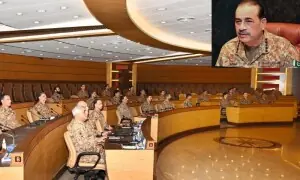
بھارتی حمایت یافتہ دہشت گردوں سے بغیر رعایت نمٹا جائے گا: کور کمانڈرز کانفرنس

خسارے میں چلنے والے اداروں کی شفاف طریقے سے نجکاری کی جائے: وزیراعظم

پی ٹی آئی نے وزیراعظم کی مذاکرات کی پیشکش کو مسترد کردیا
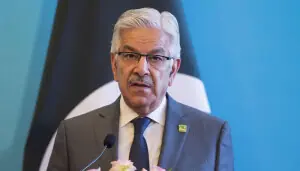
عمران خان اسٹیبلشمنٹ سے رشتہ جوڑنے کے لیے آج بھی تیار ہیں: خواجہ آصف






اس کہانی پر تبصرے بند ہیں۔